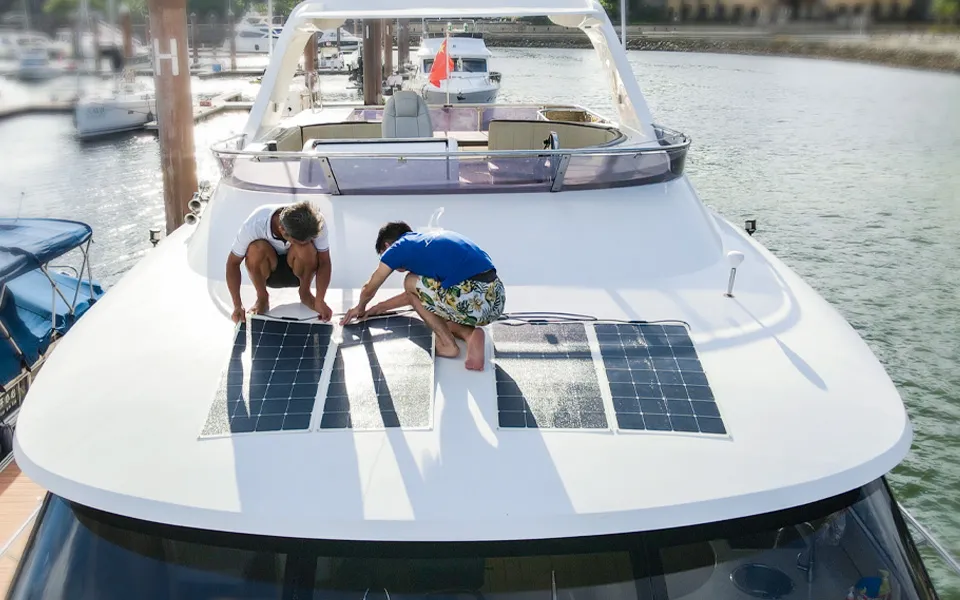
For most RV owners, we recommend monocrystalline solar panels due to their high efficiency and compact size. Flexible solar panels are particularly well-suited for RVs because they can contour to curved roofs, weigh significantly less than rigid panels, and install without drilling additional mounting holes. For typical RV use, a 100W to 200W panel provides adequate power for lights, device charging, and small appliances. If you run heavier loads like a refrigerator or microwave, consider 300W to 400W total capacity.
The wattage you need depends on your power consumption. A basic setup for lights, phone charging, and a small fan typically requires 100W to 200W. For moderate use including a TV, laptop, and a compressor fridge, plan for 200W to 400W. Full-time RVers who run air conditioning, microwaves, and other high-draw appliances may need 600W to 1000W or more. We recommend auditing your daily power consumption in amp-hours first, then sizing your solar array to produce 20-30% more than your daily need to account for cloudy days and seasonal variation.
Running an RV air conditioner on solar is possible but requires a substantial system. A typical 13,500 BTU RV air conditioner draws 1,200W to 1,800W while running, with startup surges reaching 2,500W or more. To run it for several hours, you would need a large solar array (800W to 1200W+), a high-capacity battery bank (400Ah to 800Ah lithium), and a 3,000W+ inverter. Most RV owners find it more practical to use solar for other loads and rely on shore power or a generator for air conditioning.
Yes. Modern RV energy systems support integrated multi-source charging. MPPT solar charging harvests energy while on the road or at camp. A DC-DC alternator charger tops up your house battery while driving. And shore-power AC provides full charging at campgrounds. A built-in BMS (Battery Management System) optimizes charging and discharging across all sources, and many systems include a mobile app or touch display for real-time monitoring and control. Zenel's complete RV solar kits include integrated multi-source charge management for seamless power wherever you travel.
Yes, you can connect multiple solar panels to increase charging speed. Panels can be wired in series (positive to negative) to increase voltage, or in parallel (positive to positive, negative to negative) to increase current. Series connections are generally preferred for RVs because they maintain better performance in partial shading and allow thinner gauge wiring. However, make sure your charge controller can handle the combined voltage and current. An MPPT charge controller is recommended for multi-panel setups as it optimizes power conversion efficiency.
Shading has a significant impact on solar panel performance. Even a small shadow covering 5-10% of a panel can reduce output by 30-50% or more due to how solar cells are wired in series. For RV installations, common shading sources include air conditioning units, TV antennas, vents, and nearby trees. To minimize shading effects, we recommend using panels with bypass diodes, which allow current to flow around shaded cells. Installing panels in parallel rather than series also helps, as shaded panels won't drag down the performance of unshaded ones.
Flexible solar panels offer several technical advantages for RV applications. First, they weigh 70-80% less than equivalent rigid panels, typically 4-6 lbs versus 15-26 lbs, which is critical for weight-sensitive RV roofs. Second, they can bend up to 30 degrees to follow curved roof contours without compromising performance. Third, their ultra-thin profile (2.5mm to 3mm) minimizes wind resistance and maintains a low center of gravity. Fourth, they use advanced ETFE surface coating instead of glass, providing superior UV resistance, self-cleaning properties, and durability. Finally, installation is simpler since they can be bonded directly with adhesive, eliminating the need for metal mounting brackets.
Marine-grade solar panels must withstand harsh conditions including saltwater exposure, high humidity, constant vibration, and extreme UV radiation. Key features include IP67 or IP68 waterproof ratings, corrosion-resistant junction boxes with marine-grade sealing, ETFE or specialized polymer surface coatings that resist salt degradation, and reinforced backing materials. Zenel marine panels also undergo additional salt-spray testing and carry certifications for marine use. The junction box and wiring use tinned copper conductors to prevent corrosion in saltwater environments.
A typical sailboat or motorboat solar system includes 200W to 600W of solar panels, a 20A to 40A MPPT charge controller, and a 200Ah to 400Ah deep-cycle battery bank. Smaller day-sailors may only need a single 100W panel to keep house batteries topped up for navigation electronics and lighting. Cruising boats with refrigeration, autopilot, and watermakers typically install 400W to 800W. Many boaters combine rigid panels on hardtops or bimini frames with flexible panels on curved deck surfaces to maximize available space.
Shading from sails, booms, and rigging is a common challenge for marine solar installations. On sailboats, shadows move throughout the day as the boat changes course, making partial shading nearly unavoidable. The best solution is to distribute panels across different areas of the boat (cockpit hardtop, deck, stern arch) and wire them in parallel with individual charge controllers or use panels with optimized bypass diodes. Some marine installers also use solar panel optimizers that allow each panel to operate independently, maximizing harvest even when some panels are shaded by rigging.
Marine solar panel installation varies by boat type and panel style. Flexible panels can be bonded directly to smooth deck surfaces using marine-grade adhesive such as 3M VHB tape or Sikaflex sealant. Rigid panels are typically mounted on stainless steel or aluminum frames attached to stern arches, bimini tops, or radar mounts. All wiring should be marine-grade tinned copper, routed through waterproof cable glands, and protected in conduit where exposed. Junction boxes must be mounted above the waterline in protected locations, and all connections should use heat-shrink adhesive-lined terminals.
Yes, Zenel offers full custom sizing for marine solar panels. We understand that boat deck spaces come in irregular shapes and dimensions that standard panels cannot fill efficiently. Our engineering team can design panels to your exact length, width, and curvature requirements. Custom options include specific voltage outputs to match your battery system, integrated wiring routing, and even corner cutouts to accommodate deck hardware. Contact our team with your deck dimensions and power requirements for a custom quote.
Off-grid solar systems are ideal for any location without access to utility power. Common use cases include livestock electric fences, remote CCTV and IoT towers, traffic signals and flashing beacons, marine and river buoys, environmental sensors, gate openers, trail counters, and cabins or sheds. Zenel supplies off-grid solar kits sized for 24/7 reliability with MPPT charge controllers and LiFePO4 batteries.
The choice depends on your installation surface and requirements. Flexible panels (like the Zenel PA219 series) are lightweight and low-profile, conforming to curved or irregular surfaces such as pipes, domes, and buoy housings—ideal where wind drag and weight matter. Rigid panels (like the Zenel SGM series) are glass-laminated and framed for poles, walls, and ground frames, offering higher impact resistance and easy bracket mounting. If your surface is non-flat or you need a specific footprint, Zenel can also custom-engineer flexible modules.
Follow these steps: (1) Estimate daily energy by summing device watts × hours (Wh/day). (2) Pick autonomy days (days without sun), then battery Wh = Wh/day × autonomy ÷ allowable DoD (e.g., 0.8 for LiFePO4). (3) Array watts ≈ Wh/day ÷ (peak-sun-hours × 0.75–0.85). (4) Choose an MPPT charge controller and wiring to match array voltage/current and battery chemistry. Zenel's engineering team can assist with complete system design.
Yes. Most solar fence chargers are low-duty loads. A typical setup uses a 50–100W panel (rigid or custom small flexible), a 12V LiFePO4 or AGM battery (20–50 Ah), and a 10–15A MPPT controller in a weather-sealed box. Add a simple tilt bracket (winter tilt ≈ latitude + 10–15°) and oversize the array in snowy regions for reliable year-round operation.
Yes. For a single IP camera plus radio, plan 100–300W of panels and 50–150 Ah at 12V LiFePO4, depending on duty cycle, night IR use, and climate. Use rigid panels on a mast with anti-vibration brackets, or flexible panels when weight and wind profile must be minimal. Prefer MPPT control, a fused combiner, proper strain relief, and PoE or DC conversion sized for surge loads.
Yes. Traffic signals and flashing beacons are burst or duty-cycled loads, making them well-suited for solar. Choose rigid panels for robust pole mounting with anti-theft hardware. Where sign faces curve or space is tight, a custom flexible module can fit the panel outline. Include NEMA/IP-rated enclosures, lightning and TVS protection, and nighttime reserve capacity (1–3 days autonomy).
Yes. Flexible panels are ideal for curved buoy housings and low weight over water. Pair with sealed LiFePO4 batteries, marine-grade cabling, and corrosion-resistant hardware. For partial shading from antennas or bird spikes, Zenel offers anti-shade stringing options to keep output stable even in challenging marine conditions.
Common mounting approaches include: (1) Poles and walls — rigid panels with stainless brackets and anti-theft bolts. (2) Curved housings — flexible panels with adhesive or riveted edge strips. (3) Portable and temporary — fold-flat backplates with quick-disconnects and fused leads. Always weatherize with IP67/68 junctions, drip loops, UV-rated ties, and glanded cable entry for long-term reliability.
A typical balcony solar system (400W to 800W) can generate 300-600 kWh per year depending on your location, orientation, and shading. At average European electricity rates, this translates to annual savings of 100-200 EUR. With a complete system cost of 400-800 EUR, most balcony solar setups achieve full return on investment within 3-5 years. For B2B customers managing multiple properties, start by defining the load target (tenant sockets vs. common areas), modeling kWh yield based on orientation and shading, and applying local tariff and export rules. Include capex (kits, mounts, wiring, labor) and opex (monitoring app, service), then set payback and IRR thresholds per property type. We recommend piloting 10-20 units first to validate performance before scaling.
Yes, certification requirements vary by country but are generally mandatory. In the European Union, balcony solar systems must comply with CE marking requirements and relevant electrical safety standards. In Germany, systems must comply with VDE-AR-N 4105 for grid connection and carry certification from recognized testing bodies. Common required certifications include IEC 61215 (design qualification), IEC 61730 (safety qualification), and specific inverter certifications. Zenel balcony solar panels carry all major certifications including TUV, CE, and UL, ensuring compliance with regulations across European and global markets.
Yes, micro-inverters are an excellent choice for balcony solar systems. Unlike traditional string inverters, micro-inverters convert DC to AC at each individual panel, which provides several advantages for balcony installations. First, they eliminate the need for a separate central inverter, simplifying installation. Second, they optimize each panel independently, maximizing output even if one panel receives partial shade from nearby buildings. Third, they produce grid-ready AC power directly, allowing you to plug into a standard household outlet in many jurisdictions. Popular micro-inverter brands compatible with Zenel panels include Enphase and Hoymiles.
When properly installed and certified, balcony solar systems are very safe. Key safety considerations include using panels and inverters with proper certifications (CE, TUV, UL), ensuring secure mounting to prevent panels from falling in high winds, using weatherproof electrical connections rated for outdoor exposure, and following local electrical codes for grid-tied connections. Modern micro-inverters include built-in rapid shutdown capability and anti-islanding protection. Zenel's balcony solar panels undergo rigorous safety testing including hail impact, wind load resistance up to 2400 Pa, and fire resistance ratings to ensure safe operation in residential environments.
Balcony solar panels often face more shading challenges than rooftop installations due to nearby buildings, trees, and balcony structures. Even partial shading from a neighbor's building or balcony railing can reduce output significantly. To mitigate this, we recommend using panels with bypass diodes that allow current to route around shaded cells, positioning panels to maximize southern exposure (in the Northern Hemisphere), using micro-inverters instead of string inverters so each panel operates independently, and choosing high-efficiency monocrystalline panels that perform better in low-light conditions. A thorough site assessment before installation can help you understand expected shading patterns throughout the day and year.
Balcony solar installations are subject to several international and regional standards. Key standards include IEC 61215 for panel design qualification and type approval, IEC 61730 for panel safety qualification, IEC 62109 for inverter safety, and IEC 62716 for ammonia resistance testing. In Germany, the VDE-AR-N 4105 standard governs the connection of generating plants to the low-voltage network. In other European countries, similar national standards apply. Additionally, building codes may dictate mounting requirements, wind load ratings, and fire safety setbacks. Zenel provides documentation for all relevant certifications to streamline your local approval process.
Yes, Zenel provides comprehensive OEM and ODM services for balcony solar panels. Our OEM service includes manufacturing panels to your specifications with your branding and packaging. Our ODM service goes further, with our engineering team designing complete balcony solar solutions tailored to your target market's requirements. We can customize panel wattage (from 50W to 400W), dimensions, frame color, junction box placement, cable length, and connector type. We also offer custom packaging, localized documentation, and certification support for your target markets. Minimum order quantities are flexible and we support both small trial orders and large-scale production runs.
Regulatory compliance for balcony solar varies significantly by country and region. In Germany, systems up to 600W can be registered through a simplified process with your grid operator. In Austria, balcony solar systems under 500W are exempt from the Green Electricity Act registration requirement. France requires a declaration to the grid operator but has simplified the process for small installations. Southern European countries are progressively adopting similar streamlined procedures. Zenel provides comprehensive compliance documentation with every shipment, including certified test reports, CE declarations of conformity, and technical data sheets. We also offer region-specific compliance packages for bulk orders to help our B2B partners navigate local requirements efficiently.
Wind safety is critical for balcony installations, especially on high-rise buildings. Zenel's mounting solutions are validated through wind tunnel and CFD testing with anchor pull tests where applicable. All panel and mount assemblies are tested for uplift and vibration resistance. Key safety measures include safety tethers as secondary retention on high-rise installations, low-profile tilt angles to reduce wind catch, straps and clamps with rated load capacity and UV resistance, and a periodic inspection schedule (visual checks and torque verification). Installation SOPs include photo documentation per unit, with torque specifications and part numbers kept on file. All results are documented in a site safety dossier for landlord and regulatory compliance.
Yes. Zenel supports B2B customers deploying balcony solar across multiple properties. We recommend creating 2–3 standardized core kits (e.g., 400W, 600W, 800W configurations) plus mounting variants for different balcony types. Each kit includes fixed cable lengths, standardized plugs, and app onboarding steps with a unified BOM and part numbering system. For fleet management, we provide a central dashboard for asset and serial tracking, photo SOPs for installers, and a feedback loop with quarterly review of failures and returns. OEM options include custom branding, color, cable sets, packaging, and quick-start guides. Compliance documentation can be co-branded on request. Contact our B2B team for volume pricing and deployment support.